

The meeting ends. You have five minutes before the next one, and would rather spend them settling than choosing another thing to do. A breathing cue gives those minutes a shape. The useful question is how much we can promise about what follows.
Stillness is an experimental research app exploring paced breathing, light and optional camera feedback. Published studies inform its design. They have not established that this particular app reduces stress, and opening it does not enrol anyone in a research study.
A breathing rhythm is a starting point, not a promise about how you should feel.
Why this number keeps appearing
Heart rate naturally changes with breathing. At a sufficiently slow rhythm, those changes can line up with the body's blood-pressure regulation and grow larger. Researchers call this resonance. For many people, the rhythm is around six breaths a minute; the exact rate varies. Lehrer and Gevirtz's explanation also contains a useful caution: changing breathing can change the heart-rate pattern without independently demonstrating a lasting change in the nervous system.
Think of the number as the starting mark on a dial. It gives us something concrete to investigate. It doesn't tell a person what they must feel when they arrive there, or turn a bigger wave on a graph into a health result.
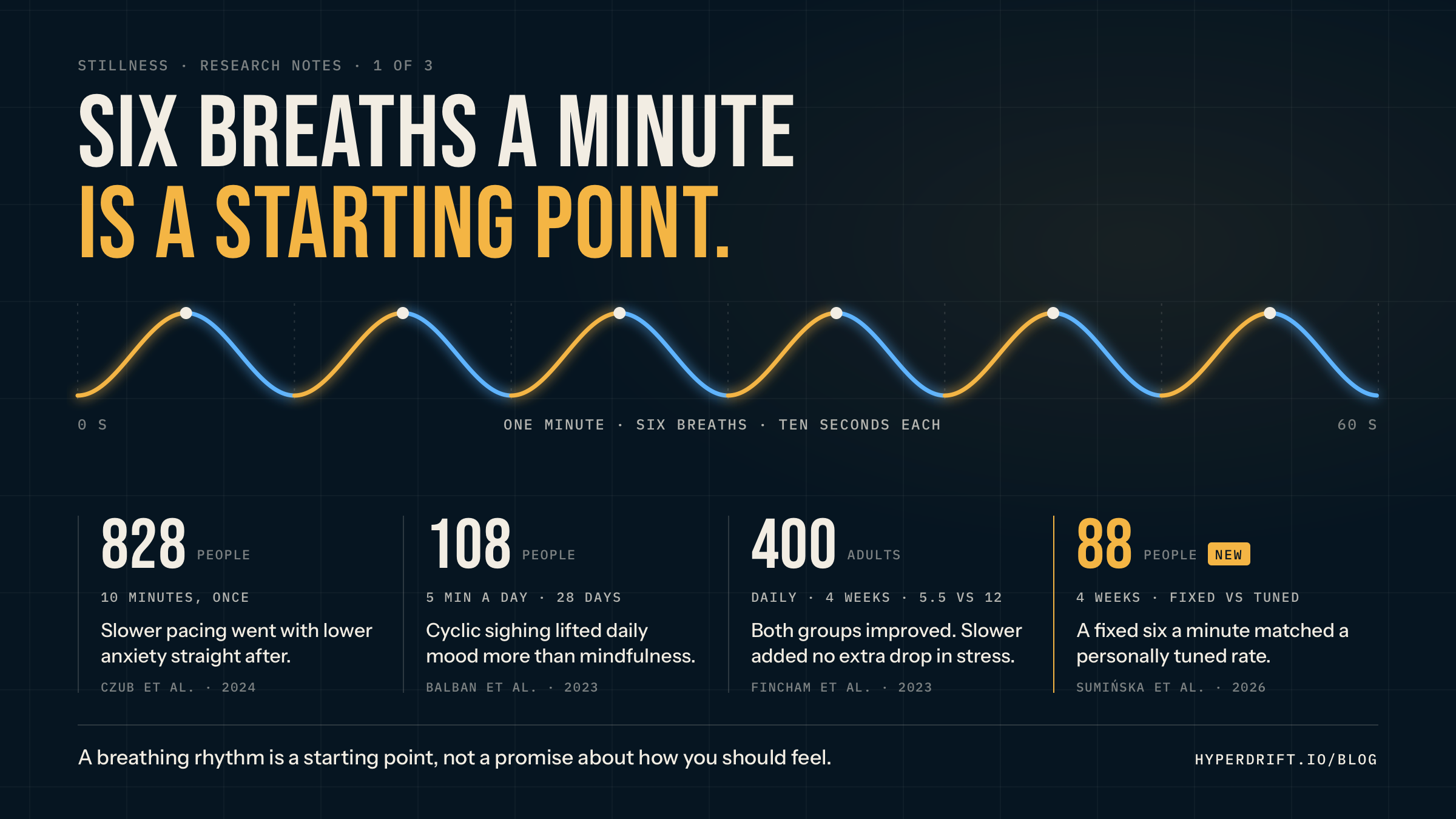
One online experiment offers a reason to investigate slower pacing. Among 828 people completing a ten-minute exercise, rates varied from six to twelve breaths a minute. Slower rates were associated with lower anxiety afterward; the balance between inhalation and exhalation showed no significant relationship. That finding belongs to the tested range and immediate questionnaire. It doesn't tell us that slower is always better. Czub and colleagues, 2024.
The comparison that changes the story
Now put two people side by side. Both hear a calm guide, take ten minutes away from their day, and follow a breathing rhythm. One is paced at roughly 5.5 breaths a minute, the other at twelve. If both report less stress, how much did the special number contribute?
That was the useful challenge in a randomised trial of 400 adults. After four weeks of daily practice, the slower group had no measurable advantage over the matched comparison on the main stress outcome. Both groups improved. The questionnaire concerned stress over the previous week, so this result doesn't settle what happens during an individual session. It does rule out treating “slower” as a guaranteed extra benefit under that protocol. Fincham, Strauss and Cavanagh, 2023.
The comparison matters to anyone building a wellbeing tool. A quiet break, attention and expectation deserve a place in the explanation. We need a way to tell what the proposed ingredient adds.
What the sighing study actually tested
Cyclic sighing adds a second inhale before a long exhale. In a widely discussed Stanford study, people practised their assigned exercise for five minutes daily over 28 days. The 108 participants were divided among three breathing exercises and mindfulness. Cyclic sighing showed a greater increase in positive mood than mindfulness in the analysis of daily changes. Breathing and mindfulness did not differ on state-anxiety changes, and resting heart rate and heart-rate variability did not significantly change. Balban and colleagues, 2023.
The study was exploratory, registered retrospectively and limited by small groups. Its result is a reason for further investigation. It cannot establish that a few introductory sighs are the fastest route to calm.
Signal — the calibration step may be optional. In May 2026, a randomised comparison gave 88 people four weeks of heart-rate-variability biofeedback: one group at a personally measured resonance rate, one at a fixed six breaths a minute, alongside a control group. Both breathing groups reduced stress, anxiety and depressive symptoms against the control, with no meaningful difference between them, and resting heart-rate variability did not change. The authors ask for larger samples before firm conclusions. Sumińska, Rynkiewicz and Szulczewski, 2026. One thing to try this week: if your exercise asks people to calibrate before they breathe, test a fixed six-a-minute start against it.
What Stillness contributes
Stillness combines a short sighing introduction with a cue that gradually approaches a preset 5.5 breaths a minute. That sequence is an app design choice; it is different from the complete protocols above. The contribution is an inspectable experience where the rhythm, supporting papers and open questions sit together.
The next useful evidence would separate whether people can comfortably follow it from whether they find the experience helpful. Session counts can answer a product question. They cannot answer a health question.
This continues the original Stillness experiment. The other pieces explore light as a breathing cue and what a camera can estimate.
Send this to the person choosing the breathing exercise for their app or workshop. Explore Stillness and its research, or bring us a better comparison.