

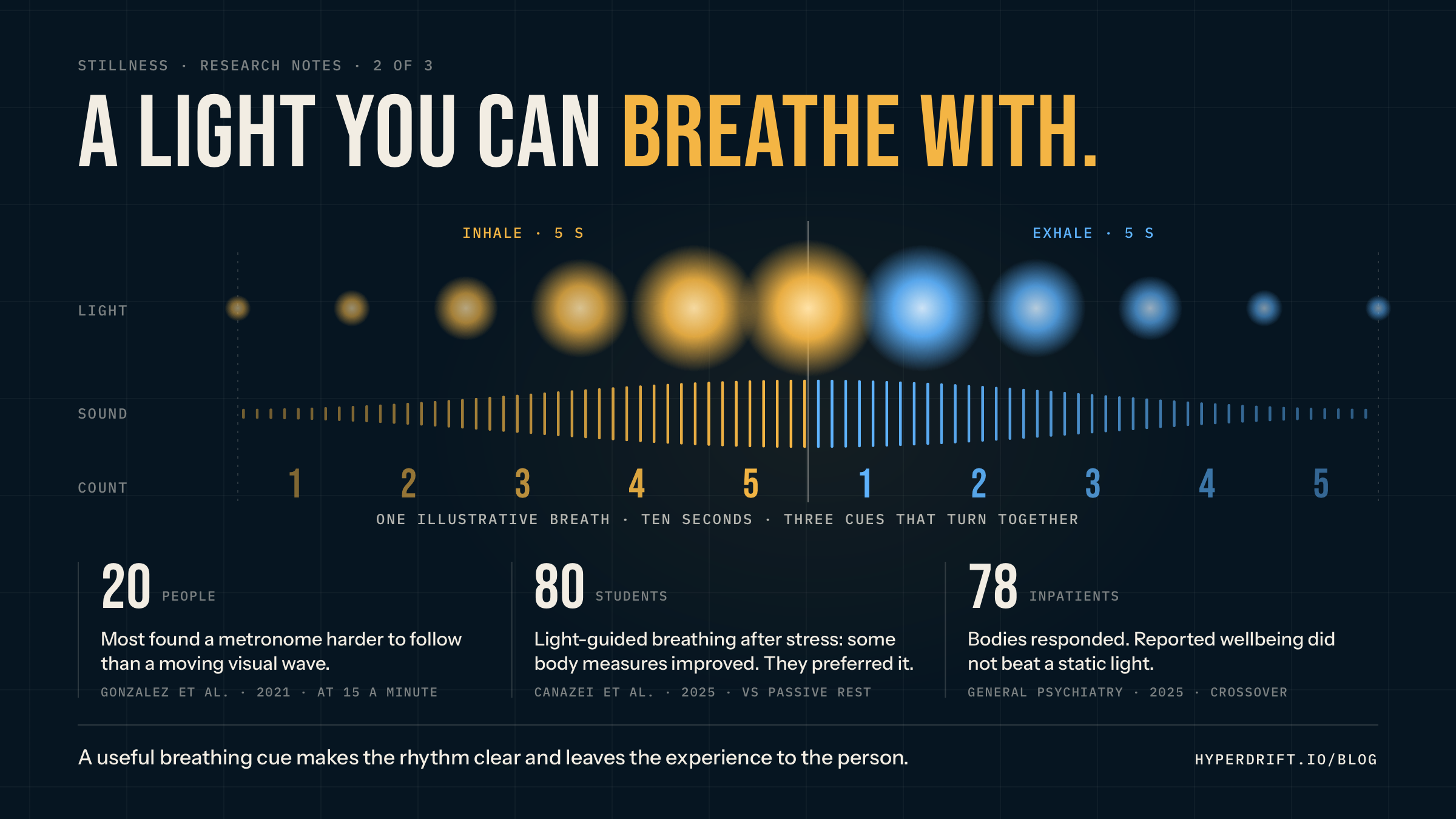
You want a quiet break, then find yourself counting seconds and checking whether you've reached the next instruction. A light that grows with the inhale and recedes with the exhale offers another way to follow. The design opportunity is simple: make the rhythm apparent without giving someone more work.
That is the question behind Stillness, an experimental research app using light and sound to guide breathing. Light communicates the exercise. Whether that experience helps a particular person needs its own evidence.
A useful breathing cue makes the rhythm clear and leaves the experience to the person.
A cue can carry the instruction
Imagine three ways to give the same instruction. A counter marks time. A sound marks the next phase. A field of light changes continuously, showing where the breath is within the cycle. None needs to announce a winner. They place different demands on attention, hearing and vision.
The interesting design question is what a person can understand without repeatedly checking a legend. If expansion means inhale at the beginning, it should continue to mean inhale later. If a sound is carrying the transition, it should agree with what the light is doing. A beautiful effect earns its place by making that relationship clearer.
There is some experimental evidence for asking which cue is easier. A study of twenty people compared a metronome with a scrolling visual waveform. Most respondents found auditory pacing harder, while the measured autonomic responses did not differ by cue. Crucially, the experiment used fifteen breaths a minute. It examined cueing at that pace, not the effectiveness of a slow-breathing treatment. Gonzalez and colleagues, 2021.
What the light-guided study adds
A laboratory study involving eighty healthy university students compared five minutes of light-guided breathing with passive rest after stress tasks. Researchers calibrated the breathing rhythm individually. Some physiological measures improved with the exercise, participants preferred it, and subjective strain improved after the cognitive task. Canazei and colleagues, 2025.
That makes light-guided breathing worth investigating. It does not tell us how much light itself contributed: the intervention changed both the guidance and the breathing. To answer the interface question, we would need to hold the exercise steady while changing its cue.
Nor does an individually calibrated laboratory session validate every app set near six breaths a minute. Stillness uses a preset slow rhythm. Its own sequence, screen, sound and everyday setting need to be evaluated as the experience they actually form.
The graph and the person answer different questions
A separate study offers a valuable limit. Seventy-eight psychiatric inpatients with persistent somatic symptoms took part in a comparison of light-guided breathing and sham static-light sessions alongside their inpatient care. Physiological responses changed, but the breathing intervention showed no specific advantage on the main self-reported wellbeing and arousal outcomes. Randomised crossover trial, 2025.
This is precisely the distinction a designer should keep visible. A person can follow an instruction successfully without receiving the hoped-for benefit. A signal on a graph cannot overrule their account of the experience.
The practical consequence is to ask separate questions. Could they understand the cue? Could they follow comfortably? How did the session feel? Collapsing these into one “success” score would hide which part of the design needs attention.
Signal — the screen can now stay awake for the whole exercise. A light only guides breathing while the display is on, and many phones dim long before five minutes are up. The Screen Wake Lock API now works in Chrome, Edge, Firefox and Safari, so a web page can keep the display lit while a session runs and hand control back when it ends. web.dev, May 2024. One thing to try this week: request a screen wake lock when your guided exercise starts, release it when it stops, and ask again when the page comes back from the background.
Make the experiment inspectable
Stillness connects its light and sound to the same breathing sequence. That is an implementation choice readers can inspect, rather than an established advantage of combining the two. We have not demonstrated that the complete experience outperforms a simpler pacer, or that its effects endure after the session.
The useful next comparison would change one element while preserving the rest. Keep the rhythm and duration fixed, for example, then compare how people follow a visual cue and an audio cue. Record discomfort and missing observations alongside favourable reports. That would teach us something a completion counter cannot.
The wider contribution is a design principle: make the instruction easy to perceive, then let people tell you whether it helped. Calm does not need a more elaborate interface by default.
Read why the breathing rate is a starting point, what a camera can estimate, or the original prototype story.
Send this to a designer choosing between an animation, a sound and another instruction. Explore Stillness and the supporting research. If you work on perceptual cues or breathing studies, help sharpen the comparison.