 Hyperdrift


I made Traction because I’m inspired by high achievers, particularly the founders whose determination makes startups possible.
A founder’s potential deserves to be judged on more than their ability to pitch or who they know. I want eager founders to have the support to get an important idea out there, and a fair chance to find out whether people will use it.
Building an app, launching it and earning adoption are difficult, distinct jobs. Often, weeks pass between them. Help arrives sporadically. Technical work absorbs the time that was meant for talking to customers. Even a small team can lose touch with its market while working hard every day.
That gap is why I created Traction: to give founders a team focused on turning their vision into growth, with the continuity that occasional advice cannot provide.
What takes founders away from their vision?
Across almost thirty years of work, I’ve seen a few patterns undermine that effort.
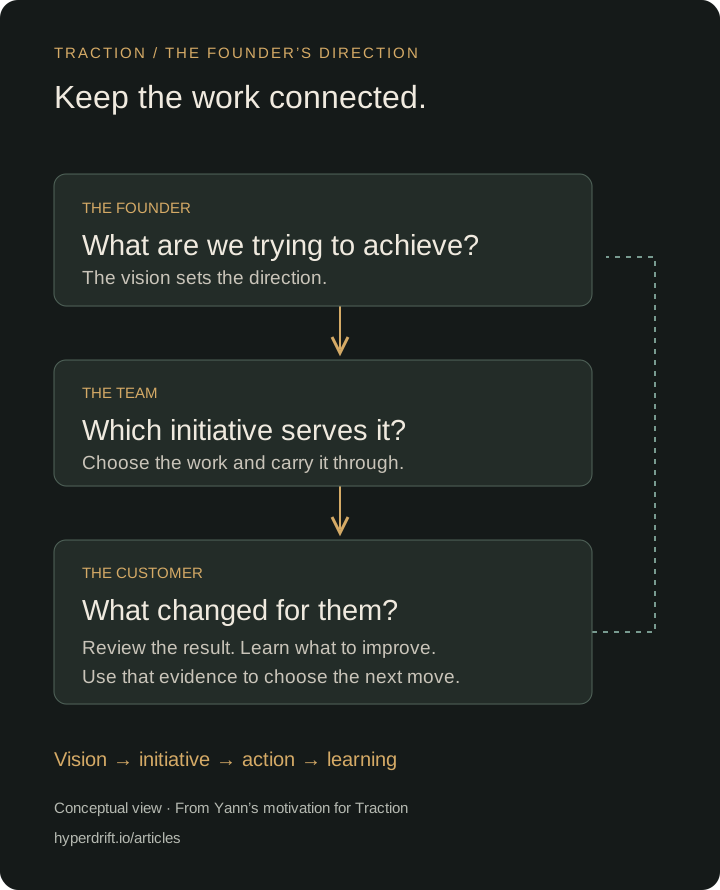
The first is poor communication. People work on initiatives without a shared understanding of how they serve the founder’s vision. A technical decision, a sales conversation and a product change can each make sense in isolation while pulling the business in different directions. Every initiative needs a clear connection to what we are trying to achieve.
The second is hiring too quickly once funding arrives. More people bring more capacity, but also more coordination. Teams form silos. New frameworks appear to organise the work. Technical debt grows as separate teams build around separate priorities. The founder can end up managing an organisation before the product has found its market.
The third is acting like a large company too early. Processes for a bigger organisation, and preparations for markets we are not yet serving, take attention from the people we could help now. Complexity needs to earn its place through what the business actually needs.
There are two tempting responses to uncertainty: keep polishing the product, or chase every sign of demand until it starts to resemble the competition. Both can take us away from the reason we started. The founder’s vision gives the work direction; customers tell us whether the way we are pursuing it is useful. We need to keep the two in conversation.
A team that keeps the work connected
This is the purpose of Traction. We’re building AI into a team that brings initiatives, market intelligence and customer relationships together around your app. Its job is to challenge the work, including its own proposals: how does this help the app reach people, deliver value and grow?
That question applies to a feature, a campaign, a CRM update or another coordination meeting. Engineering and customer support belong in growth when they help people use the product and keep using it. Work that has lost that connection needs to be reconsidered.
The ambition is a team that carries initiatives through implementation and review, learns from what happened and adjusts the next move. Day after day, the work should become better informed. You should be able to see what was done, what changed and what deserves your attention next.
Explanation and primary sources
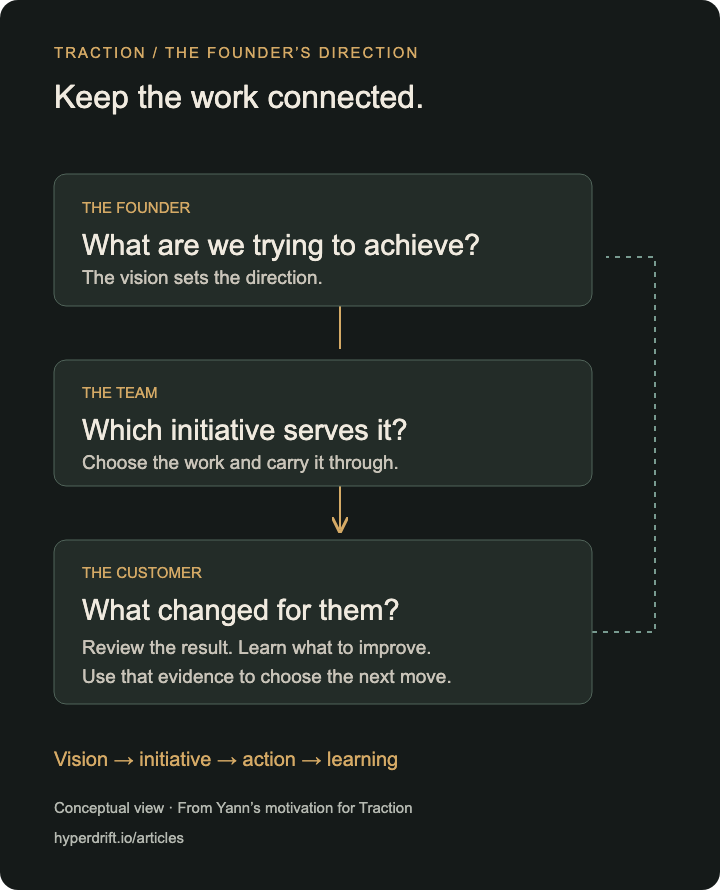
A conceptual view of the argument in this article. Choose work that serves the vision, carry it through and review what changed for customers before choosing the next initiative. It describes the intended way of working, not a measured growth result.
- Traction: how it works
Give the idea a chance to support you
Early revenue matters here. It gives you confidence and evidence that someone values what you have made. It can help establish credibility for a first funding round. Or it can support a smaller business that earns recurring income from an idea you believe deserves to exist. Raising investment does not have to be the destination.
A paid campaign does not have to be the starting point either. Understanding who needs the app, reaching them and following through are work in their own right. Spending on attention cannot replace that relationship.
Even with a clear focus on growth, success is uncertain. You want every chance on your side. Traction is there to help guide and implement the work, organise it and support communication. It needs your judgement, your feedback and your willingness to act. You are the heart and soul of Traction.