

Research series3 articles
Stillness: breathing, light & what we can measure
Three research questions behind an experimental breathing app. What might help, what a camera can measure, and where the evidence stops.
Explore the seriesIdeas to build on
What we’re learning, and how it could help what you build next.
Research series3 articles
Three research questions behind an experimental breathing app. What might help, what a camera can measure, and where the evidence stops.
Explore the series
5 min read
A simpler life doesn't need a shopping list. GreenLife returns with one daily nudge to want less, make room for what matters and reconnect with the living world. Independent. Not for sale.
Read the article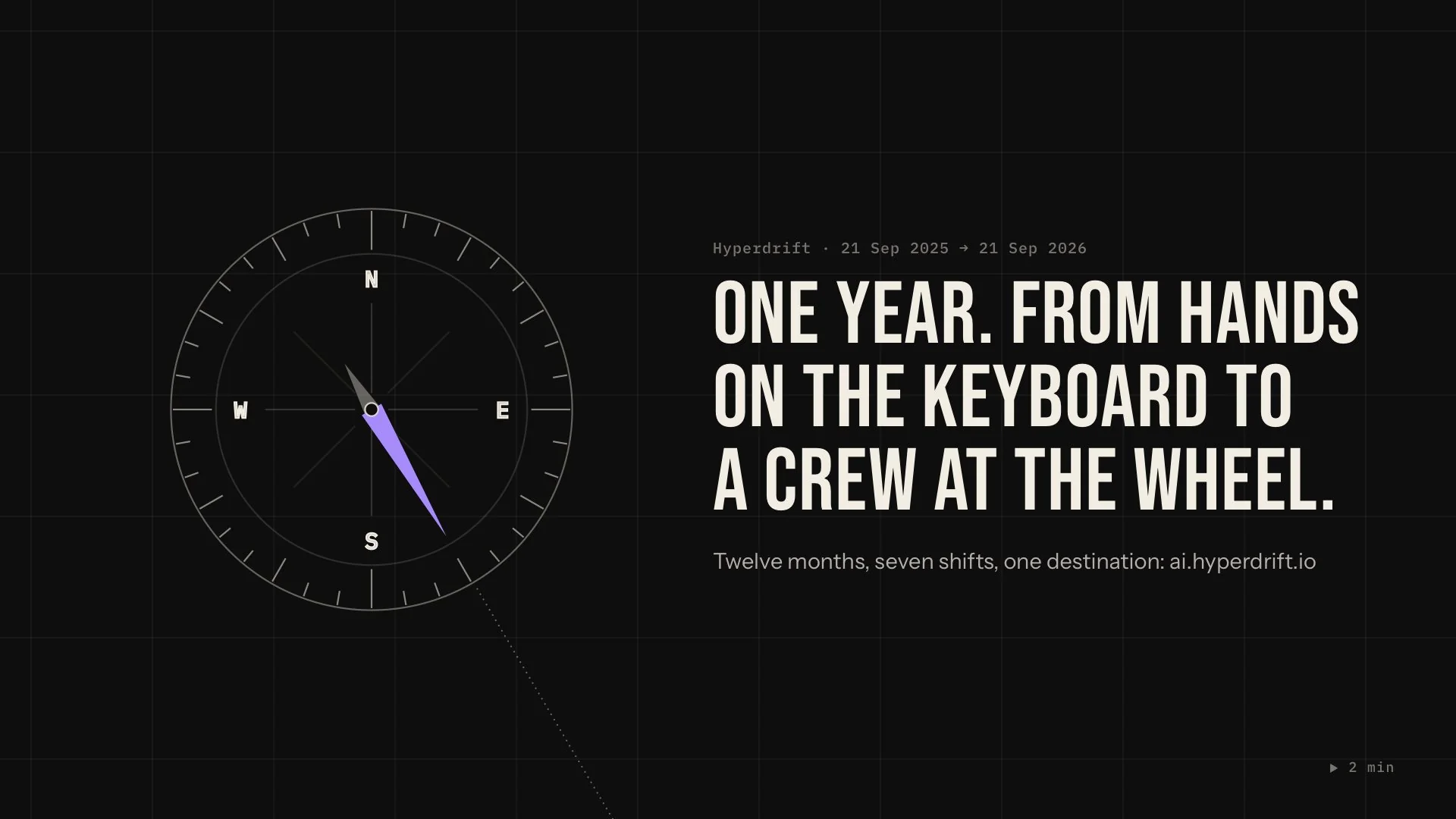
12 min read
Twelve months ago Hyperdrift said its first public words. Since then the way the work gets done changed seven times — manual coding, skills, Databricks, orchestration, frontier models, judges — and it points somewhere. The whole year, charted and filmed, with a link to everything we shipped and every line of it that's open.
Read the article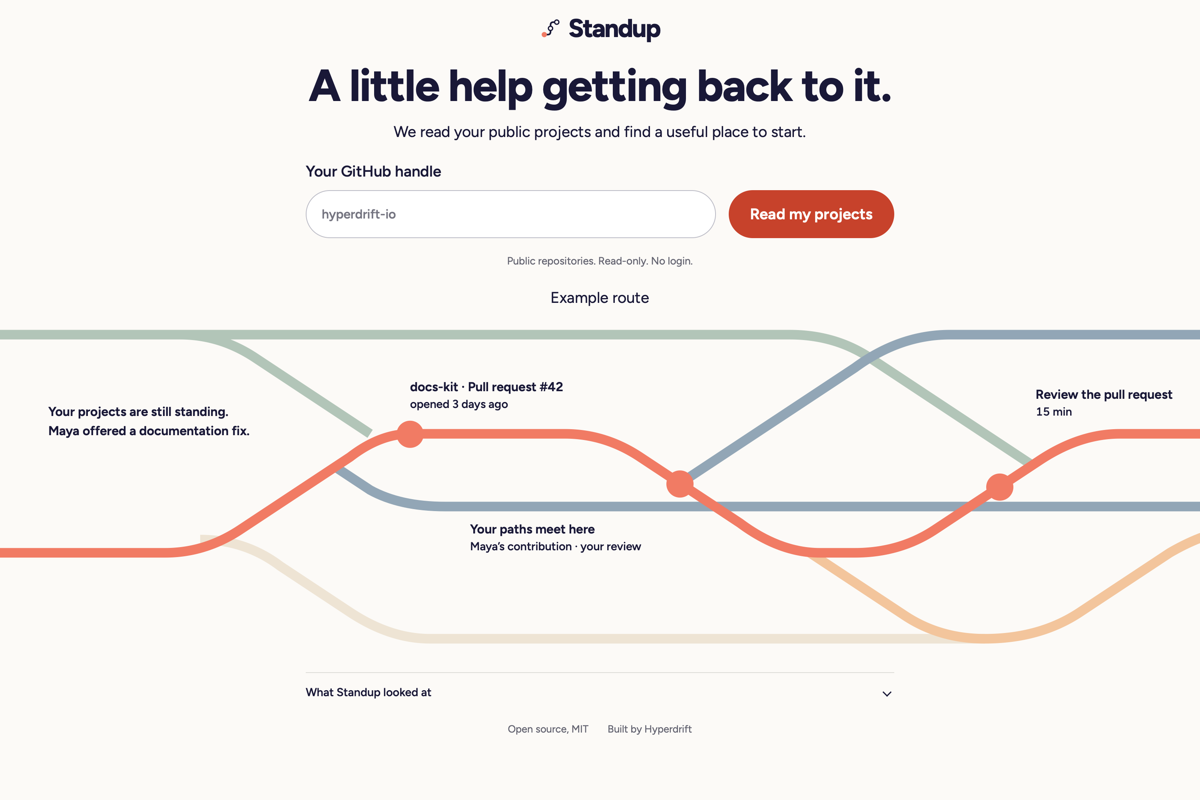
3 min read
Coming back to your projects should not start with six tabs and a guilt trip. Standup reads your public GitHub and answers three questions: what to start with, who is waiting, and how long it takes.
Read the article
3 min read
Right now 25,987 issues carry a help-wanted label from the person who runs the repo, and not one reply. The people who could answer exist. The ask never reached them.
Read the article
4 min read
We gave an agent crew the power to take a production service offline, then went looking for what could turn that power against us. The hole was not in the model. It was in the telemetry.
Read the article
4 min read
We keep building accounts so a website can remember who you are. Your agent already knows. WebMCP lets a page hand the agent its controls, and the site never has to hold your context at all.
Read the article
3 min read
Sixty lines of nginx config took our worst page from 1.5 seconds to 89 milliseconds. The edge you're told to rent is the proxy you already run — and we're publishing the whole secret.
Read the article
3 min read
Analytics has always waited for you to ask. PostHog's new signals invert that — and we wired them into the daily command cycle that steers our fleet of apps.
Read the article
2 min read
Together is testing a simple promise: help people already sharing a public place discover mutual interest and meet face to face. Its public survey lets anyone help choose where that first room should exist.
Read the article
2 min read
The Ascent is an immersive human-capacity matrix for seeing what today can carry. Its foundation never changes: know the whole person, find the right balance, then make the right call.
Read the article
Engineering series2 articles
Two connected articles on building a product with a stack you can understand, change and keep. From server rendering to types across the whole app.
Explore the seriesLet’s make something useful
Tell us who you want to help and what you’d like to make possible. We’ll work out the next step together.